
Claire Whitfield looks after forty holiday rentals scattered across wine country — the sort of properties where one bad review can cost a week of bookings.
The message arrived at 6:42 on a Saturday morning, four hours before check-in. Two stars, photograph attached: a rust ring circling the toilet in one of her best-performing listings.
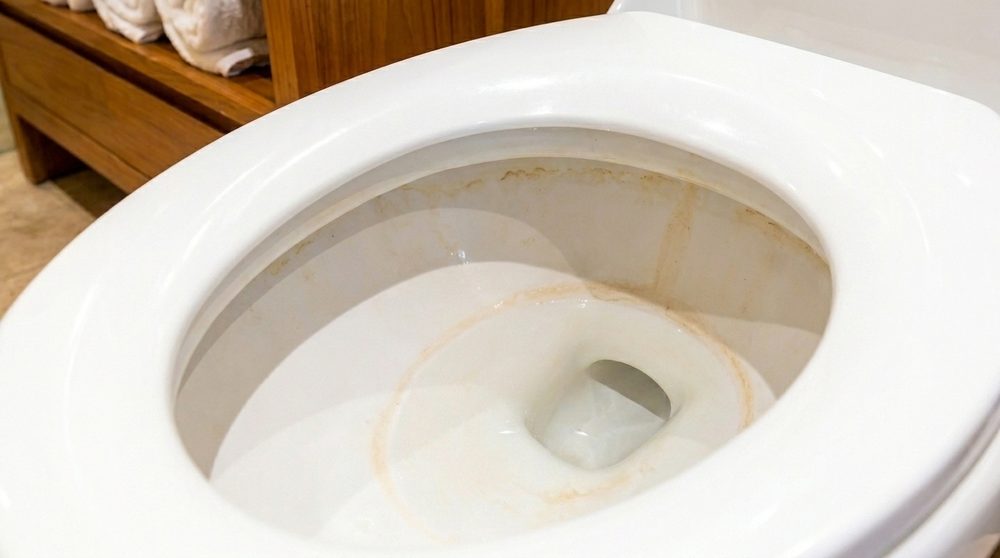
It looked spotless when she left. Two days later the ring was back — darker, and faster than before. The listing lost its Guest Favourite badge that quarter and three bookings quietly cancelled in the same week.
It was happening in bathroom after bathroom
“The stains weren't just coming back,” Claire says. “They were coming back faster every time. Like the toilet remembered being dirty.”
And there was a pattern in it she could not explain away. The toilets her crews scrubbed most aggressively were, without exception, the ones that stained again soonest. That is precisely backwards from how it is supposed to work.

What pushed her to actually do something about it was Rosa Delgado, who has been with her since the first property. Rosa had cleaned a thousand toilets — bleach, harsh cleaners, scrubbing hard enough and often enough that her hands ached by the end of every shift, in small bathrooms with the door shut.
“I figured it was just getting older. You don't really question it. You just keep going.”
Rosa Delgado, cleaning crew leadClaire wanted something that did not involve harsh chemicals in an unventilated room, and did not require anyone to scrub at all. That search led her to Kevin Tolbert, who spends his working life repairing antique fixtures most people would have skipped decades ago.

What the restorer told her
“We've been told all our lives that the only way to really clean a toilet is to scrub it,” Kevin said. “It's the opposite. The scrubbing is what's making it worse.”
The part nobody mentions about porcelain
Porcelain is finished with a glaze that is meant to stay glass-smooth. That smoothness is the whole defence — there is nothing for a mineral deposit to grip.
Every pass of a stiff bristle brush cuts microscopic scratches into that glaze. Individually they are far too small to see. Collectively, over years, they become a mesh of tiny traps — and they are too small for the same brush to ever reach into.
Rust, hard-water minerals and mould settle into those traps and anchor there. So the harder and more often a bowl is scrubbed, the more traps it has, and the faster the next stain locks in.
Kevin's analogy: think of a non-stick pan. The first year everything slides off. Attack it a few hundred times with a scouring sponge and suddenly everything sticks. The pan did not degrade on its own. The scrubbing did that.
Which raised the obvious question. If abrasion is the problem, how do you clean something without it?
Kevin's answer came from his own trade. Antique restorers never scrub, because abrasion is exactly what destroys a piece worth keeping. They use controlled oxygen-based reactions that lift grime out of a surface without touching it.
What she ended up making
Claire spent months testing formulas built on that principle — a foam that lifts a stain loose rather than grinding at it — tuned specifically for the glaze inside a toilet bowl rather than the antique fixtures in Kevin's workshop. She called the result RestoraBowl, after the restoration idea it came from.
“I didn't want a stronger brush. I wanted something that finally stopped needing one.”
Claire Whitfield, founder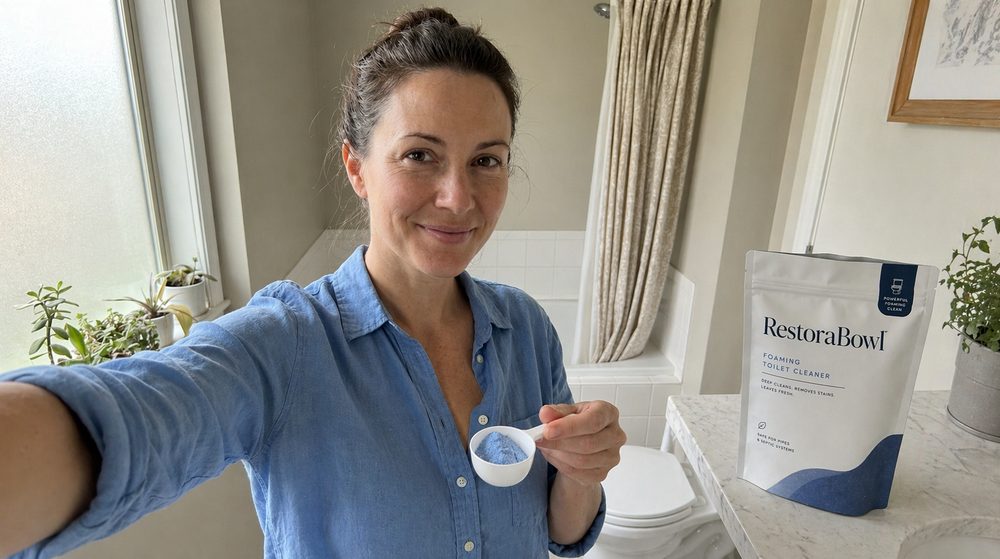
The first real test was a guest bathroom in one of her own units, with a hard-water ring that had outlasted three retail cleaners over two years. She poured a scoop in, let it foam, and walked away for fifteen minutes. No brush touched the bowl. When she came back and flushed, the ring was gone in one pass.
How the routine actually works
Pour
One scoop of powder straight into the bowl. No gloves-and-goggles ritual, no decanting.
Wait
It foams and expands for about fifteen minutes. You are not standing over it — go and do something else.
Flush
Once. That is the whole job — no second treatment, no follow-up scrub.
The mechanism behind that: the moment the powder meets water it releases a dense foam of expanding micro-bubbles, small enough to travel into the microscopic traps that years of brushing left behind — the ones a bristle brush is physically far too large to reach. Once inside, the reaction breaks the stain loose from underneath and lifts it off the glaze instead of grinding against it. A single flush carries it out.
Works on rust, hard-water and mould-based staining
No brush, no scrubbing, no kneeling on a bathroom floor
Stated by the maker as safe for pipes and septic systems
No bleach smell left hanging in a small room afterwards
Suits old and new porcelain, standard and low-flow bowls
“I wasn't expecting much”
Rosa had been cleaning rentals for eleven years by the time Claire handed her a bag, and she did not hide her scepticism. “I've used pumice stones, I've used bleach overnight, I've used everything. I told Claire I'd try it, but mostly I was just tired.”
She tried it on the worst toilet in her rotation — a unit she had stopped even attempting to fully clean.
“I stood there and watched it happen and I still didn't believe it until I flushed. But it wasn't just that the stain was gone. It was that my hands didn't hurt that night.”
Rosa DelgadoRosa still works Claire's turnover days. She has not scrubbed a toilet since, she is no longer spending her shifts breathing bleach in a room with the door shut, and her hands no longer ache by the end of one.

The emails Claire keeps
What she says she likes most are not the reviews. They are the messages that have very little to do with stains.
“My son left for college this autumn. The first time I visited his dorm I was horrified — I don't think that toilet had ever been cleaned. I left him a few bags half as a joke. It's so easy he actually uses it, and now his whole floor is asking where he got it.”
Kayla T. · Roseville, CA“I'm seventy-eight and my hands don't work the way they used to. I hadn't been able to get down and scrub my own toilet in about two years, and it embarrassed me enough that I stopped having people over. Now I can do it myself again. Thank you for giving me back a piece of my independence I didn't think I'd get back.”
Margaret H., 78 · Dayton, OHWhy it isn't in the supermarket
When it started to take off, distributors came calling with offers to put it on shelves and into marketplace warehouses within weeks. Claire turned them down.
“The formula is made to sit at room temperature, the way it would under somebody's bathroom sink. A warehouse doesn't work that way — it gets hot and nobody's checking any one pallet. I'd rather sell fewer bags and know every one of them works.”
Claire WhitfieldSo it is sold direct through the company's own site, with a discount for new customers. It is also, by the maker's own account, made in small batches rather than mass-produced — which is the honest reason it has sold out more than once.